A ski skincare packing list splits into four places: hand luggage for the journey, a jacket pocket for the mountain, main luggage for everything else, and the accommodation bathroom for morning and evening. Creams, gels and sunscreens count as liquids at security; solid balm bars do not. Airport rules vary by country and change over time, so check the guidance for your departure airport, your airline and any connecting airports before you fly.
The scene repeats itself every February. A queue at security, a bin of confiscated toiletries, and someone explaining to an officer that the tin is not really a cream. Behind them, somebody else has just discovered that a flip-top bottle of moisturiser has emptied itself into a ski sock.
None of it is complicated. It goes wrong because skincare gets packed last, at midnight, into whatever bag has room. Five minutes of sorting turns it into the easiest part of the trip — and gets the right things into the right pocket, which is the bit that actually matters once you are on a mountain.
This guide is for skiers, snowboarders and families flying to the snow. It covers what the cold, dry mountain does to skin, how security categorises what you are carrying, a routine for the travel day itself, and a four-location packing list you can work straight through.
A single day takes you from a dry cabin, through a cold transfer, into a heated apartment, and out onto a bright mountain. That is four environments before you have made a single turn.
| Stage | What it does |
|---|---|
| Cabin air | Aircraft cabin humidity is low, and a flight plus airport time is a long stretch in dry air |
| Dehydration | Long travel days usually mean drinking less than usual, with coffee and alcohol adding to it |
| Cold transfers | Standing about with luggage in a resort car park at altitude, often in wind |
| Wind | On the mountain you generate your own on top of the weather |
| Snow glare | Snow reflects a large proportion of UV back upwards, including under the chin and nose |
| Altitude | Drier air, and UV intensity increases as you climb |
| Indoor heating | Apartments and chalets run warm, and heated air is dry air |
The response is not a bigger washbag. It is having the right small things in reach at each stage, which is exactly what the packing list below is arranged around.
Security categorises products by physical form, not by what they are for. That single fact explains most of what follows.
The practical consequence: every liquid item you swap for a solid one frees space in the liquids bag for the things that genuinely have to be liquid. On a ski trip, that is usually sunscreen.
It also helps to keep the liquids together and near the top of the bag rather than distributed through it. Most delays at security are caused by someone having to unpack a whole rucksack to find a tube, not by the tube itself being a problem. If you are travelling with children, put everyone’s liquids in one bag and carry it yourself.
One caveat worth stating: no format guarantees anything at security, and no one can promise that a particular product will be allowed through. Format affects how you should pack, not what an officer will decide.
Liquid allowances differ between countries and airports, and several are changing as scanning technology is upgraded. Three points people get wrong:
For UK departures, the Government publishes current hand-luggage restrictions, and individual airports publish their own guidance. Take two minutes over it the week before you fly.
A simple rule: hand luggage carries what you need on the journey and what you cannot replace. The hold carries volume.
Cabin humidity is low, which is why skin and lips feel tight after a couple of hours. Nothing dramatic is required.
Transfers are the forgotten part of a ski trip: a cold coach park at altitude, luggage, wind, and often the first proper exposure of the holiday.
Cleanse gently, moisturise, then sunscreen on everything that will be exposed — including ears, under the chin, under the nose and the strip between goggles and helmet. SPF lip balm on, spare in the pocket. Balm on cheeks and the backs of the hands if it is cold and windy.
Lip balm at every lift queue or coffee stop. Reapply sunscreen through the day according to the product directions, particularly after a sweaty morning or a long lunch in the sun. If a goggle or helmet strap is rubbing, sort it at lunch rather than at the end of the day.
Damp base layers and boot liners off first. Cleanse properly to remove sunscreen and sweat, moisturise while skin is still slightly damp, and pay attention to hands, lips and anywhere a strap has been sitting. Muscle rub on tired legs if that is your habit — most people reach for it around day three.
The one non-negotiable in the bag. UV intensity increases with altitude, snow reflects a large proportion of it back upwards, and cloud reduces it less than most people assume. Temperature tells you nothing about UV at all.
Apply generously in the morning, reapply through the day per the product directions, and cover the places that catch reflected light from below. Mineral sunscreens using non-nano zinc oxide reflect UV at the skin surface rather than absorbing it, and a zinc-based cream in an oil base does not tend to sting when it mixes with sweat, which is why it suits children and anyone who works hard on a mountain.
Ski bags go missing more often than suitcases, because they get handled separately and transferred late. It is worth thirty seconds of planning rather than a ruined first day.
| Product | What it is for | Security category | Where it goes |
|---|---|---|---|
| Protective balm | Cheeks, nose, ears and hands before exposure | Usually treated as a cream | Jacket pocket |
| Moisturiser | Morning and evening, dry cabin and heated rooms | Liquid | Hand luggage (small) and bathroom |
| Lip care | Wind, dry air and reflected UV — the most-used item | Cream or solid, depending on format | Pocket, always |
| Sunscreen | Broad-spectrum protection on snow, reapplied | Liquid; aerosols have extra rules | Ski bag, plus a small one in the pocket |
| Cleanser | Removing sunscreen and sweat at the end of the day | Liquid, unless a solid bar | Main luggage |
| Hand care | Hands between damp gloves and cold air | Usually treated as a cream | Hand luggage and bedside |
| Solid balm bar | Multi-purpose, ultralight, no leak risk | Not a liquid | Anywhere — including hand luggage |
The printable version
Hand luggage: lip balm ×2, small hand balm, small moisturiser, prescriptions, liquids bag on top.
Jacket pocket: SPF lip balm, 60g balm tin, small sunscreen, tissues, spare thin gloves.
Ski bag: full-size sunscreen, cleanser, moisturiser, hand and foot balm, muscle rub, sealed pouch.
Bathroom: cleanser and moisturiser out on the shelf, hand balm by the bed, sunscreen by the door.
Before you fly: check the current rules for your departure airport, your airline and any connections.
Yes, within the current liquids allowance at your departure airport, since sunscreen counts as a liquid. Many people put the full-size bottle in the ski bag and carry a small one in hand luggage so that a delayed bag does not leave them unprotected on day one. Check the current rules before you fly.
Usually, yes — semi-solid balms and creams are generally treated as liquids for hand luggage, even in a tin. Genuinely solid products such as balm bars are not liquids and do not go in the liquids bag. Rules vary by airport and change over time, and no one can guarantee how a specific item will be assessed.
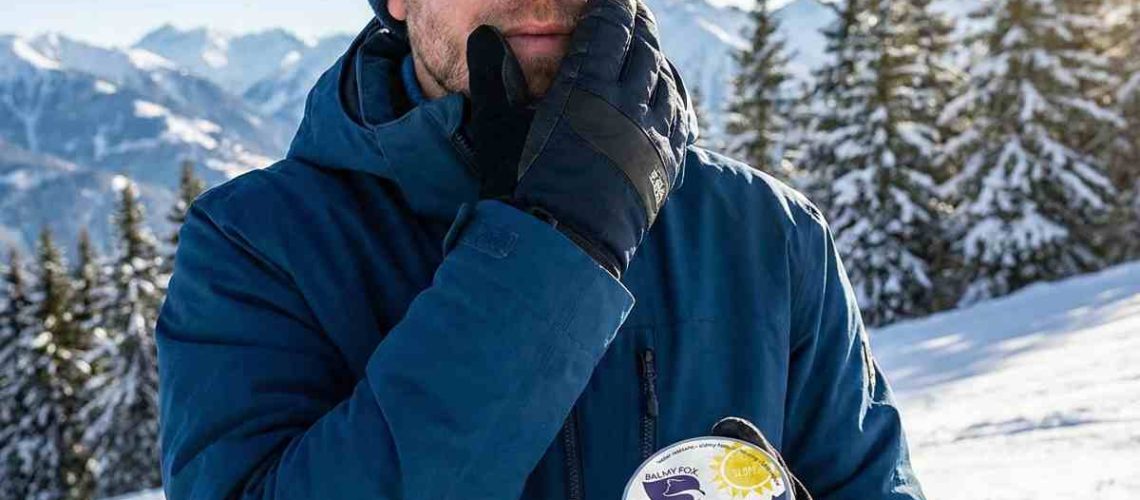
An SPF lip balm, a small tin of balm for cheeks, nose and hands, and a small sunscreen if you are out all day. Reachability is the whole point — anything that requires unzipping three layers or opening a rucksack will not get used, which is why lip balm belongs in an outer pocket.
It may go firm in a cold boot room or an outside pocket overnight, and it softens again in a warm pocket. Waterless balms do not behave like water-based lotions in the cold. Keep the tin in an inside jacket pocket during the day if you want it soft enough to apply easily.
Screw tops rather than flip tops, everything in one sealed pouch, and packed in the middle of soft clothing rather than under ski boots. Aluminium tins with a screw-top seal hold up well because there is no seam to split and nothing to crack under pressure. Solid formats cannot leak at all.
It helps. Cabin humidity is low, and a flight plus airport time is a long stretch in dry air, which is why skin and lips feel tight on arrival. Moisturise before boarding and again before landing, keep a lip balm in the seat pocket, and drink more water than you feel like.
A broad-spectrum sunscreen with a high SPF and good UVA protection. How much you apply matters as much as the number: most people use considerably less than the amount products are tested at, so being generous and reapplying beats choosing a higher factor and putting on a thin layer.
A suitable children’s broad-spectrum sunscreen, an SPF lip balm each, and a simple moisturiser. Mineral sunscreens using zinc oxide are a common family choice because they sit on the skin surface and tend not to sting eyes. Keep a lip balm in every child’s jacket pocket and reapply at lunch.
Only if you label them clearly. Decanting saves space, but an unlabelled pot is a nuisance at security and a real problem in any conversation about a reaction. Where a sensible travel size exists, buying it is usually better because it arrives sealed, labelled and in date.
Less than most people pack. A cleanser, a moisturiser, a balm, a lip balm, a sunscreen and a hand balm covers a week comfortably. A 60g tin lasts most people well beyond a single trip, so the constraint is usually sunscreen, which is the one thing worth taking plenty of.
Balmy Fox makes natural skincare in Mid Wales for cold, dry, bright places. Everything comes in 60g screw-top aluminium tins rather than plastic — pocket-sized, sealed against pressure, and recyclable indefinitely.
A solid balm bar for hands, face and dry patches. Not a liquid, so it does not go in the liquids bag at all, and there is nothing to leak in a ski bag. The simplest answer if you are flying hand luggage only. Slope Balm Bar
Broad-spectrum mineral sun protection built on non-nano zinc oxide, which reflects UV at the skin surface. Marine-safe, formulated without oxybenzone or octinoxate, and no sting when it mixes with sweat on a warm afternoon. The cream counts as a liquid, so plan for it; the lip balm belongs in a jacket pocket. Slope Sun Protection Cream SPF 25 · Slope Sun Protection Lip Balm SPF 25
The bathroom pair. A moisturiser for morning and evening in a heated apartment, and a richer 60g balm for hands and feet at the end of the day — keep that one by the bed rather than the sink, because that is when it actually gets used. Slope Moisturising Cream Tin · Slope Hand and Foot Repair Balm
Sorted before you get to the airport
Browse the Slope range for mineral SPF, lip balm, moisturiser and balm bars sized for a jacket pocket — or take a Slope kit and pack it in one go.