It’s a reasonable assumption that rain would help — after all, water is supposed to reduce friction, not increase it. On skin and fabric, the opposite tends to happen. Dry fabric slides over dry skin reasonably well. Once fabric is wet, it clings, and clinging fabric doesn’t glide, it drags. Every footstep or arm swing becomes a small tug rather than a smooth pass, and that tug is repeated thousands of times over a long run or walk.
Skin changes too. Prolonged contact with water softens the outer layer, a process sometimes called maceration, and softened skin has less structural resilience than dry skin. It’s the same reason fingertips wrinkle and soften in the bath — the surface layer absorbs moisture and becomes more fragile. Add friction on top of softened skin and the breakdown happens faster and at a lower level of rubbing than it would on a dry day.
There’s a third factor that catches people out specifically: cold rain has a numbing effect. Skin that’s cold hurts less in the moment, so the early warning signal — that first stinging hot-spot — doesn’t register the way it would on a warm, dry day. Many runners and walkers only discover wet-weather chafing in the shower afterwards, when the damage is already done and stings under warm water.
Chafing in the rain isn’t limited to any one activity. Runners training through autumn and winter get it on long steady miles where kit stays wet for an hour or more. Walkers and hikers get it on multi-hour routes where waterproofs trap moisture against skin even when the outer shell is doing its job. Cyclists get a version of it too, particularly around the saddle area, though the mechanics are slightly different because of constant contact pressure rather than repetitive swing.
The common thread is duration. A ten-minute wet dash to the car rarely causes a problem. It’s the sustained exposure — training runs, long walks, hill days, multi-day treks — where wet fabric has enough time and enough repetitions to do damage.
| Friction point | Why rain makes it worse |
|---|---|
| Inner thighs | Wet fabric drags with every stride instead of sliding; a common first hot-spot on longer wet runs |
| Underarms | Trapped moisture under a waterproof or base layer increases both dampness and friction |
| Bra line and chest | Wet elastic and seams sit tighter against softened skin than they do when dry |
| Waistband | Rucksack hip belts and running belt packs grip harder against wet fabric and wet skin |
| Feet and toes | Waterlogged socks soften skin fastest of all, which is why blisters and chafing often arrive together |
Timing and placement matter more than quantity. Apply 10 to 15 minutes before you head out, so the balm has settled into the skin rather than sitting on the surface where it can be wiped straight off by the first wet sleeve or waistband that brushes past. Focus on the areas in the table above rather than covering skin indiscriminately — a barrier only needs to sit where fabric actually meets skin under load.
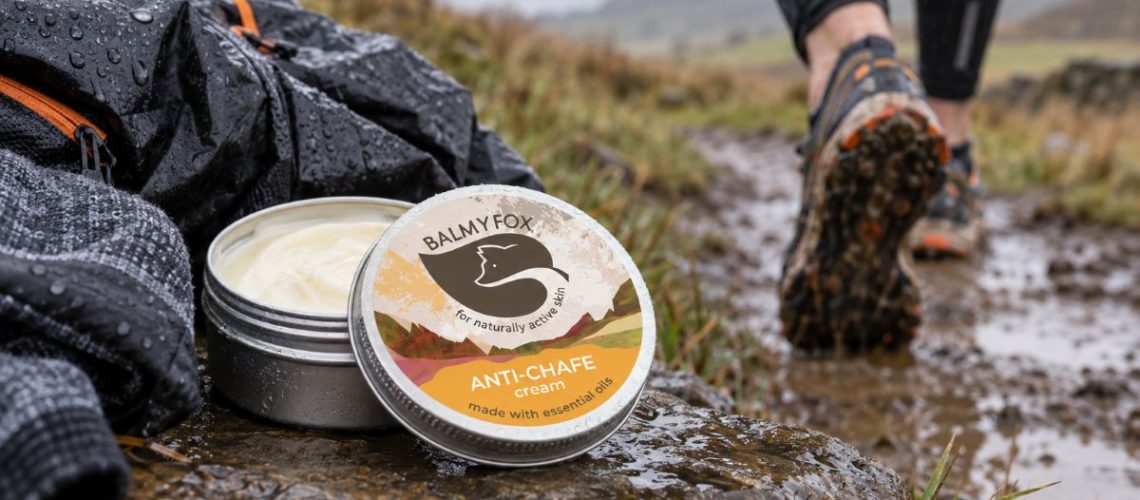
A thin, even layer works better than a thick one. Over-applying doesn’t add protection; it just gives the product more surface area to be rubbed away in the first twenty minutes, meaning you’ve used up the tin’s protection before the run has properly started. Balmy Fox’s Trail Anti-Chafe Cream is designed to be worked in fully rather than left as a visible layer — if you can still see white residue after rubbing it in, that’s more than you need.
For anything over two to three hours — a long training run, a hill walk, a multi-day trek — carry a small screw-top tin and reapply at a natural stopping point. The 60g tin is well within the airline 100ml liquids allowance if you’re travelling for a race or trip, and the screw-top seal means it won’t leak into a rucksack side pocket or bum bag even under pressure at altitude.
Used properly, a barrier-forming anti-chafe cream helps reduce friction at the point of application, for the duration it stays on the skin. That’s a genuinely useful, well-understood mechanism — it’s the same principle behind barrier creams used in a wide range of active and outdoor settings.
It’s worth being honest about the limits, though. A barrier cream applied before you go out won’t repair skin that’s already chafed from a previous run — that’s a job for a repair balm afterwards, not a preventative one beforehand. It won’t compensate for kit that doesn’t fit properly; a sports bra that rides up or shorts with a rough inner seam will still cause problems no matter how much cream is underneath. And on very long, very wet efforts — an ultra, a multi-day hike — even a well-applied barrier will need reapplying, because friction and moisture gradually wear any barrier down. Treat it as one part of a wet-weather kit strategy, not a single fix for the whole problem.
Fabric choice does a lot of the work before any cream gets involved. Cotton is the main thing to avoid for wet-weather activity — it absorbs water and holds it against the skin rather than moving it away, which is the opposite of what you want when rain is already softening skin. Synthetic technical fabrics or merino wool blends manage moisture far better, wicking it away from the skin surface even when the outer layer is soaked.
Seamless or flat-locked seams in the areas most prone to chafing — inner thigh, underarm, bra line — make a genuine difference on long wet outings, because a raised seam rubbing against already-softened skin is one of the most common causes of a specific, localised hot-spot. If you’re kitting out for a winter of wet-weather training, it’s worth checking seam placement on shorts, base layers and sports bras specifically, not just their waterproofing rating.
None of this replaces an anti-chafe cream — good kit and a good barrier cream work together, not as alternatives to each other.
Once you’re home, resist the instinct to jump straight into a hot shower if skin is already sore or broken. Hot water on freshly chafed skin stings and can aggravate the area further; a lukewarm rinse is kinder, followed by patting the area dry rather than rubbing it with a towel.
This is where a repair-focused product earns its place, applied after skin has been cleaned and dried, to help soothe and moisturise skin that’s had a rough few hours. Balmy Fox’s Trail Hand and Foot Repair Balm and Cream are formulated for exactly this kind of post-activity recovery, though they work on any dry, weather-stressed skin, not just hands and feet.
If chafed skin looks more than mildly sore — spreading redness, warmth, swelling, or any sign of pus or broken skin that isn’t healing over a day or two — that’s a job for a pharmacist or GP rather than a skincare product. Ordinary post-activity chafing settles within a couple of days with basic care; anything that looks like it’s getting worse rather than better is worth getting checked, following standard NHS guidance on skin and wound care.
British weather doesn’t take a training plan into account, and eight months of a typical year bring more grey, damp days than blue-sky ones. Own the Weather, as a way of thinking about kit, simply means not treating rain as the exception — planning for it as the normal condition you’ll be training and walking in, rather than hoping for a dry window that may not come.
That’s the thinking behind keeping an anti-chafe cream as a permanent, unremarkable part of a pre-run or pre-walk routine, alongside lacing up shoes and checking a route — not a special measure reserved for the one sunny long run of the month, but a small habit that holds up whatever the forecast says.
Yes. Wet fabric drags against skin instead of sliding over it, and skin that’s been damp for a while softens and becomes more fragile, so friction damage happens faster and at a lower level of rubbing than on a dry day.
Chafing is friction damage to skin across a broader area, usually where fabric or a strap repeatedly rubs — thighs, underarms, bra lines. A blister is a localised pocket of fluid that forms from concentrated, repeated friction in one small spot, most often on feet from footwear or socks.
Always before. Apply it 10 to 15 minutes before you head out so it settles into the skin. Applying it after you’re already wet and chafed only soothes existing irritation — it doesn’t build the barrier that prevents friction damage in the first place.
Yes, and it’s worth doing on anything over two to three hours. Carry a small screw-top tin and reapply to the usual friction points at a natural stopping point — a rest stop, a drinks station, the top of a climb.
It can, if moisture gets trapped underneath a waterproof shell against warm skin. A breathable outer layer combined with a moisture-wicking base layer manages this better than a fully waterproof shell worn directly against skin.
Petroleum jelly forms a basic barrier but has no active ingredients aimed at active skin, tends to feel heavier, and can mark technical fabric. A purpose-formulated anti-chafe cream is designed to work into the skin rather than sit on top of it.
Wet elastic and seams sit tighter and grip harder against skin that’s already been softened by moisture, so pressure points that are barely noticeable when dry become genuine friction points once everything is wet.
It depends on how many friction points you treat and how often, but a 60g tin typically covers several weeks of regular training use applied only to the areas that need it, rather than as an all-over layer.
Applying a barrier cream to already-broken or very sore skin isn’t the right use for it — that’s the point for a repair-focused balm and, if the skin looks broken or infected, a pharmacist or GP. Anti-chafe cream is a preventative measure applied to healthy skin beforehand.
Yes, and that’s part of what makes it catch people out. Cold has a numbing effect, so the early stinging that would normally warn you doesn’t register as clearly, and the damage is often only noticed once you’re warm again, in the shower.
Yes. Balmy Fox’s Vegan Anti-Chafe Cream gives the same barrier-forming approach using entirely plant-based ingredients, for anyone avoiding animal-derived ingredients like beeswax or lanolin.
The 60g tin is within the standard 100ml airline liquids allowance and has a screw-top seal, so it travels in a liquids bag without issue. If you’d rather avoid liquids restrictions altogether, the solid Balm Bar format carries no liquid classification at all.
None of these are a substitute for the fabric and pacing choices covered above — they’re what to reach for once your kit and routine are sorted.
The core option for wet-weather runners and walkers. Apply to thighs, underarms, bra line and waistband 10 to 15 minutes before heading out; the 60g screw-top tin fits a running belt, rucksack side pocket or bum bag for reapplication on longer outings.
The same barrier-forming approach as the Trail version, formulated without beeswax or lanolin for anyone following a plant-based routine. Works identically in application and timing.
For afterwards, not before. Once skin is clean and dry, this helps soothe and moisturise areas that have had a rough, wet few hours — useful well beyond hands and feet on any weather-stressed skin.
Add an anti-chafe cream to your kit bag the way you’d add a head torch or a spare buff — something that’s just there, every time, whatever the forecast says. Shop the Trail range at balmyfox.co.uk, or build a Trail Kit that covers chafing, recovery and cracked skin in one order.