Sun cream should protect you, not fight you. If you’ve ever had sweat carry sunscreen into your eyes mid-run, or watched a chemical SPF break down into a greasy film after an hour on the bike, you already know the problem. Most sunscreen wasn’t designed with active skin in mind.
Natural sunscreen — built on non-nano zinc oxide instead of chemical UV filters — takes a different approach. It sits on the skin and reflects UV rays, rather than absorbing into the skin to neutralise them. For anyone training, racing, or spending long days outdoors, that difference matters. Here’s why natural sunscreen suits active skin better, reason by reason.
This isn’t about swapping one marketing claim for another. Zinc oxide has been used as a UV filter for decades — it’s just been overtaken by chemical alternatives that are cheaper to formulate and easier to rub in invisibly. For active skin, invisible isn’t the priority. Staying protected through hours of sweat, salt water, and sun is.
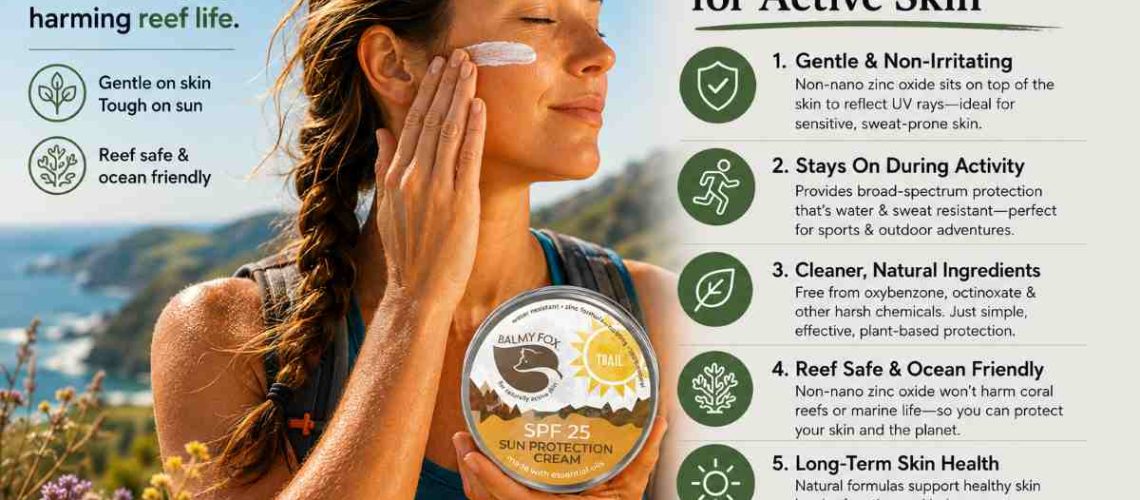
Chemical filters like oxybenzone and octinoxate are notorious for stinging eyes the moment sweat carries them off your forehead. Anyone who’s had to run the last three miles of a race half-blind knows exactly how disruptive that is.
Non-nano zinc oxide sits differently on the skin. It’s a physical barrier, not a chemical reaction, so it’s far less likely to irritate eyes when sweat runs. That’s one less thing to think about when you’re already pushing hard.
Oxybenzone and octinoxate are both linked to coral bleaching, and they’re already banned in sun cream sold in parts of Hawaii, Palau, and the British Virgin Islands. If you swim, snorkel, sail, or paddle, what washes off your skin ends up in the water with you.
Non-nano zinc oxide doesn’t carry that risk. It’s a mineral filter, not a chemical one, so it doesn’t break down coral or disrupt marine ecosystems the way oxybenzone does. Reef-safe sunscreen isn’t a marketing label here — it’s a formulation choice.
Chemical filters are absorbed into the skin to work, and for a lot of people, that’s exactly where the problems start — redness, breakouts, or a burning sensation on application. Kids’ skin and sensitive skin react the same way, just more often.
Because zinc oxide works on the surface rather than underneath it, natural sunscreen is a safer starting point for sensitive skin, sunburn-prone skin, and children. No stinging on application, no waiting around for it to ‘sink in’ before you can move.
Studies from the FDA and elsewhere have found that chemical UV filters — including oxybenzone — are absorbed into the bloodstream after a single application, with levels detectable for days afterwards. The long-term health effects are still being studied, but the direction of travel is clear enough that several filters are already under regulatory review.
Non-nano zinc oxide particles are too large to pass through the skin barrier. They stay on the surface, doing their job, and leave with a wash. For anyone applying sunscreen daily through a training block or a summer of racing, that’s a meaningful difference.
Chemical sunscreens need roughly 20 minutes to activate after application, and they break down faster under sweat, sea water, and repeated reapplication. Zinc oxide starts working the moment it’s on your skin, and it holds its structure better through the exact conditions active skin deals with — heat, salt water, friction, and hours of exposure.
This is where the wider formulation matters too. A natural wax matrix — carnauba, candelilla, beeswax or berry wax depending on the range — helps the zinc oxide stay put through sweat and swimming, rather than sliding off after the first hard effort.
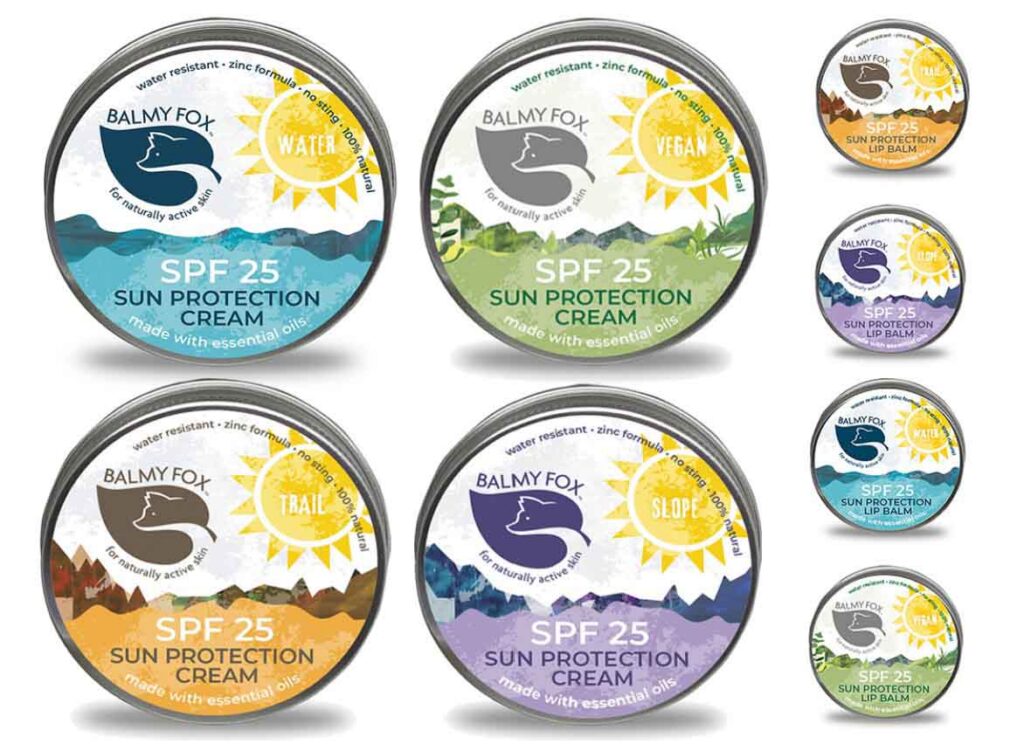
Our SPF 25 Mineral Sun Cream is built entirely on non-nano zinc oxide — no oxybenzone, no octinoxate, no chemical filters. It’s formulated across the Water, Trail, and Slope ranges, so whichever conditions you’re facing, there’s a version built for it. The Vegan range carries the same zinc oxide protection in a fully plant-based formulation.
The SPF Lip Balm covers the one area most sun creams miss entirely. Lips burn fast, especially at altitude or on the water, and a stick that fits in a jacket pocket or bike jersey means there’s no excuse to skip it.
Every tin is 60g, screw-top sealed, and well within the 100ml airline liquid allowance — no decanting, no leaks, no fuss if you’re packing for a trip.
If chemical sunscreen has ever let you down mid-activity, it’s worth switching to something built for the way you actually use it. Explore the SPF 25 Mineral Sun Cream range at balmyfox.co.uk and find the version suited to your sport.