You’ve reapplied twice, you’re sweating hard, and now you’re wondering whether there’s any SPF left on your face at all. It’s a fair question. Sweat is warm, salty, and relentless — and in conventional sunscreens, it can break down the formula and carry it straight into your eyes.
The good news is that formulation matters a lot here. Not all sunscreens behave the same way under physical stress. Understanding why — and what to look for — means you can choose a formula that actually performs when you need it to.
Most mainstream sunscreens use chemical filters (oxybenzone, octinoxate, avobenzone) dissolved in a water-based emulsion. When sweat hits those formulas, it emulsifies the lotion — essentially dissolving it. The sunscreen slides off, runs into your eyes, and stings. You end up wiping it away. SPF gone.
The problem isn’t unique to cheap formulas. Even well-known sports sunscreens can struggle under sustained sweat — particularly when the formula relies on silicones or synthetic film-formers to stay in place. These work in the short term but aren’t built for hours of exertion in heat.
Mineral sunscreens behave differently. Zinc oxide sits on top of the stratum corneum (the outermost layer of skin) rather than absorbing into it. It doesn’t dissolve in water or sweat — it’s a mineral particle, not a chemical compound. The challenge for formulators is keeping that zinc oxide layer stable and uniform when sweat or water hits it. That’s where the wax matrix comes in.
Plant-based sunscreens like the Balmy Fox range use a blend of natural waxes — carnauba, candelilla, beeswax, berry wax, sunflower seed wax — as the structural backbone of the formula. These aren’t just texture ingredients. Each wax plays a specific role in keeping the formula intact under pressure.
Carnauba wax has one of the highest melting points of any natural wax. It forms a hard, temperature-stable film that resists migration in the heat — important when you’re running on a warm day and your face is generating real warmth. Candelilla wax binds oils tightly into the formula, preventing separation. Sunflower seed wax has an exceptionally high oil-binding capacity, which stops the formula from going patchy or pooling in skin creases under pressure.
The softer waxes — beeswax and berry wax — add flexibility to that structure. A formula built only on hard crystalline waxes would crack and flake as skin moves. Soft waxes keep the film pliable, so it moves with your skin rather than breaking apart. Think of it as the difference between a brittle shell and a flexible but waterproof membrane.
When all these waxes are properly balanced with the vegetable oil carrier phase — almond, hemp, borage — the result is an oleogel structure: a locked, hydrophobic network that repels water rather than absorbing it. Sweat doesn’t emulsify the formula. It beads and runs off. The zinc oxide stays where you put it.
In the UK and EU, a sunscreen can claim ‘water resistant’ if it retains a meaningful SPF rating after 40 minutes of water immersion, tested under controlled laboratory conditions. ‘Very water resistant’ (or 80-minute resistant) is the stronger standard, used in some markets.
These are useful benchmarks, but worth interpreting honestly. Lab immersion tests don’t replicate two hours of surfing, or the specific chemistry of salty seawater mixed with sweat. They give you a reasonable signal that a formula has been engineered with water exposure in mind — not a guarantee it will last indefinitely without reapplication.
For outdoor sport, reapplication every 90 minutes to two hours is the sensible approach regardless of the formula. More frequently if you’re in and out of water, sweating heavily, or towelling off. A good water-resistant mineral sunscreen buys you time between those applications — but it doesn’t eliminate the need for them.
Chemical filters aren’t just less resistant to sweat — they create an additional problem for athletes. When the formula dissolves in sweat, those chemical compounds run directly into eyes and mucous membranes. Oxybenzone in particular is known to cause significant eye stinging. If you’ve ever had to squeeze your eyes shut mid-race because of sunscreen, this is why.
There’s also a systemic concern worth knowing about. Chemical filters like oxybenzone are highly lipophilic — they absorb through the skin and into the bloodstream. Studies have found detectable levels in urine, blood plasma, and breast milk following application. Oxybenzone specifically has been flagged as an endocrine disruptor, with evidence linking it to altered hormonal activity.
Zinc oxide is inert. It doesn’t absorb through the skin. Non-nano zinc oxide particles (as used in the Balmy Fox range) are large enough that they don’t enter cells, don’t enter the bloodstream, and don’t interact with the endocrine system. For athletes applying sunscreen over large body areas repeatedly over a full season, that distinction matters.
Oxybenzone and octinoxate have been banned in several locations — Hawaii, the US Virgin Islands, Palau, parts of Australia — specifically because of their impact on coral reefs. Even at parts-per-trillion concentrations, these chemicals disrupt the relationship between coral and the zooxanthellae algae that feed them, contributing to coral bleaching.
Mineral sunscreens formulated without nano-particle zinc oxide and without chemical filters are the marine-safe standard. If you’re surfing, snorkelling, sailing, kayaking, or swimming in open water, the formula you wear doesn’t just affect your skin — it enters the water. For anyone who cares about the environment they’re playing in, this is a straightforward reason to choose mineral over chemical.
Each sunscreen in the Balmy Fox range is formulated with the same core mineral base — non-nano zinc oxide, plant wax structure, botanical oil carriers — adapted for the specific demands of different activities.
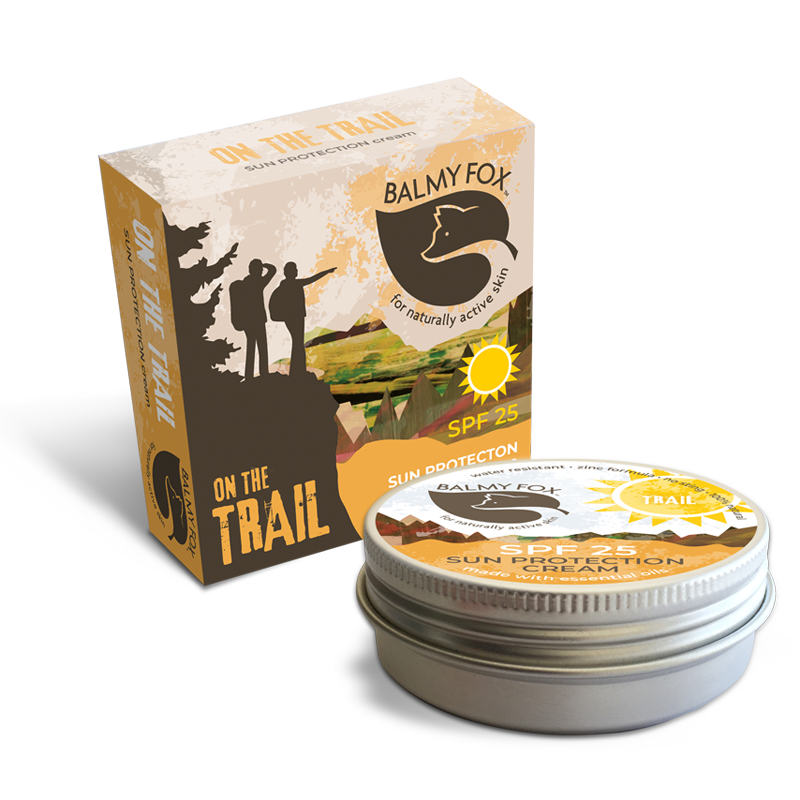
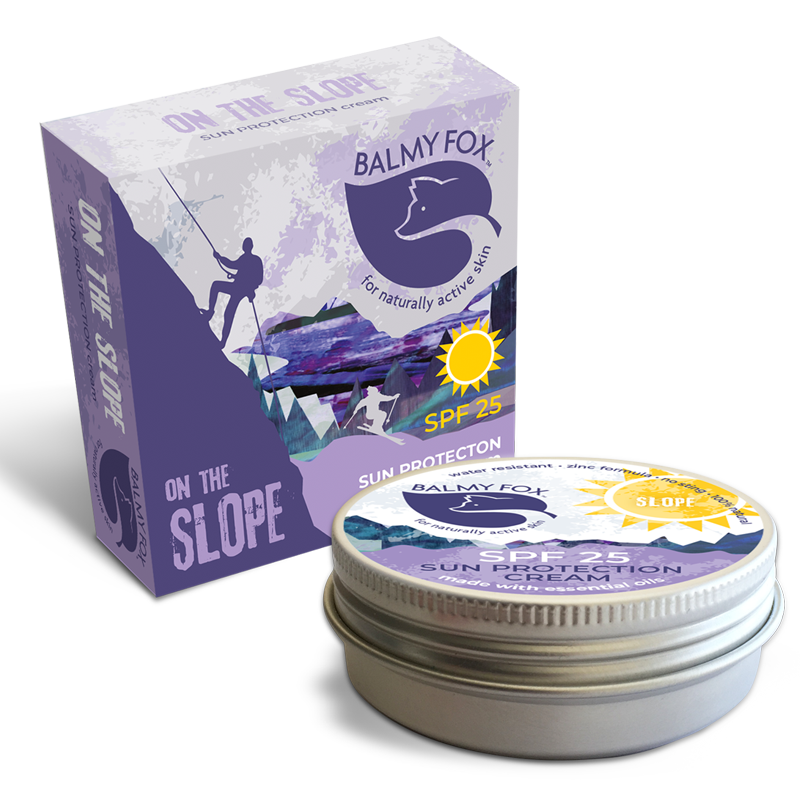
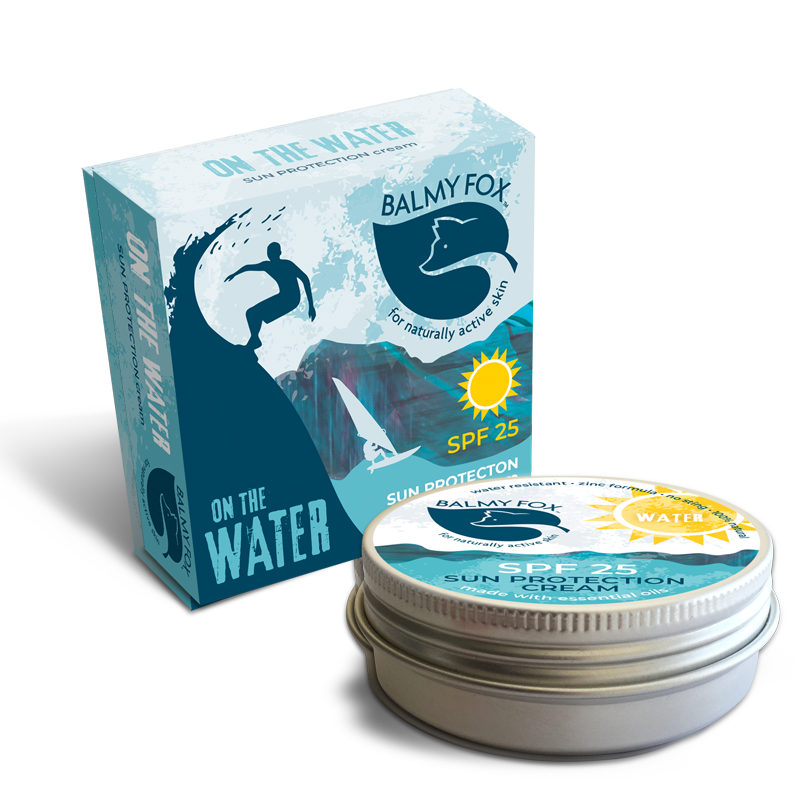
On the Water SPF 25 is the most water-focused formula, using a strengthened hydrophobic wax matrix that resists both salt water and fresh water immersion. It won’t run into your eyes while you’re in the sea. On the Trail SPF 25 prioritises breathability and a non-comedogenic feel for land-based athletes who are sweating heavily over long periods. On the Slope SPF 25 adds richer moisturising botanicals to deal with the combined challenge of UV at altitude, biting cold, and drying wind.
All three come in a 60g aluminium tin — under the 100ml airline liquid limit, screw-top sealed, and compact enough to sit in a salopette pocket, jersey pocket, or rucksack lid. No plastic. The aluminium is infinitely recyclable.
For lip protection in the same conditions, the SPF 25 Lip Balm uses a wax-heavy formula that stays on chapped lips through wind, cold, water, and salt.
If you’ve been using a formula that runs into your eyes, sits greasy on your skin, or needs reapplying every hour, it’s worth making the switch. The Balmy Fox SPF range is available at balmyfox.co.uk — browse by activity range to find the right formula for what you do. All orders ship plastic-free.