[DEET vs Natural Insect Repellent: Why Your Kit and Your Skin Will Thank You for Switching
You have sprayed on the repellent, stepped outside, and within minutes your fleece jacket has a mysterious soft patch where the fabric has quietly started to dissolve. That is DEET. Effective, yes. But effective in ways that go well beyond repelling insects.
For most outdoor activities in the UK and Europe – trail running, hiking, wild camping, mountain biking, or a long day in the Scottish Highlands – there is a smarter option. One that protects your skin, leaves your kit intact, and does not wash into the burn you are about to cross.
DEET (N, N-diethyl-meta-toluamide) was developed by the US Army in 1946, in response to the threat of vector-borne disease in the Pacific theatre. It has been the global standard for insect repellency ever since – and for genuine disease-risk environments, it earns that status.
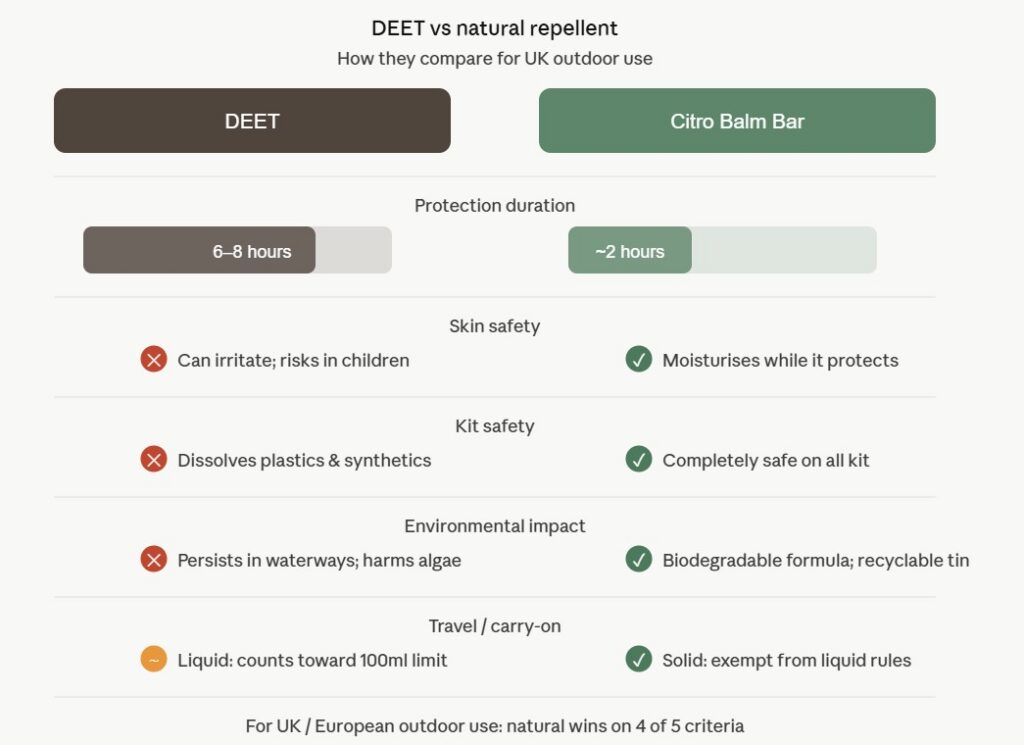
But DEET is also a powerful organic solvent. It melts plastic. It fogs watch faces. It weakens synthetic fabrics like spandex and rayon – the kind used in most running and hiking kits. Handle your GPS with DEET-coated hands, and you may find the casing starts to crack. That is not an anecdote; it is chemistry.
On the skin, DEET can cause redness, rashes, and dryness. In children, high-concentration formulations carry documented risks of neurological effects with repeated overexposure. And once it washes off, it enters waterways – where it has been detected in up to 73% of surveyed UK and North American streams, and where it causes measurable damage to aquatic life, particularly algae.
None of this is a reason to avoid DEET if you are travelling to a high-risk malaria region in sub-Saharan Africa or Southeast Asia. In those environments, protection is a medical necessity, and DEET long-duration matters. But if you are running the West Highland Way, cycling in Tuscany, or paddling in Pembrokeshire? The risk equation looks very different.
Natural repellents do not kill insects – they confuse them. Midges and mosquitoes locate their targets by detecting the CO2 and lactic acid your body emits. Plant-based essential oils create a vapour layer around the skin that disrupts those signals, making it harder for insects to locate you.
The key actives in a well-formulated natural repellent include:
The honest trade-off: natural repellents need to be reapplied every 2 hours or so, compared to 6 to 8 hours for DEET. For most UK outdoor activities, that is not a meaningful disadvantage – you are unlikely to be two hours from a pocket.
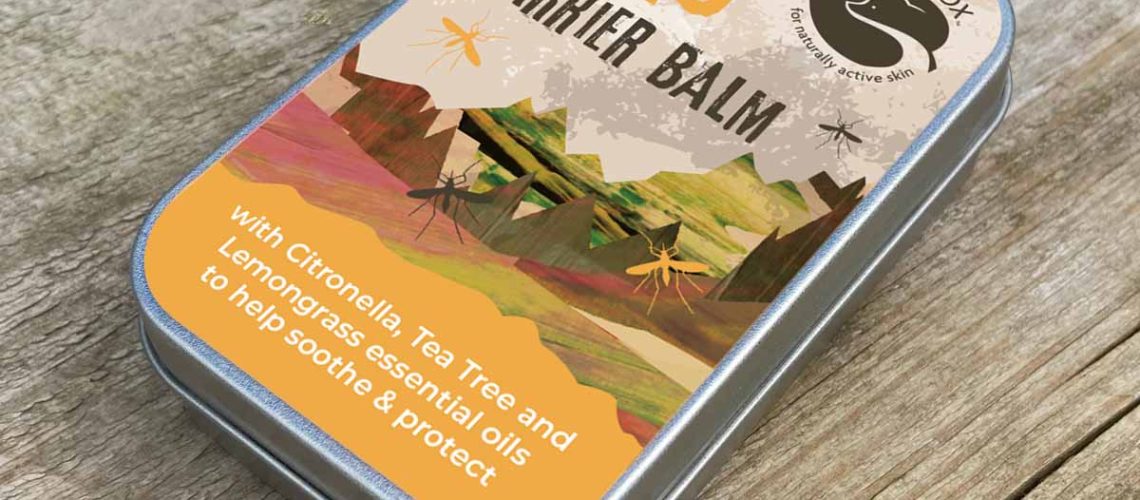
The Citro Balm Bar is Balmy Fox trail-ready natural insect repellent – a solid balm rather than a spray or lotion, formulated around an organic essential oil blend.
Sprays create airborne particles that you can accidentally inhale. Roll-ons leave wet patches. A solid balm applies cleanly, stays where you put it, and the beeswax base forms a physical barrier on the skin that is particularly useful against midges, which are small enough that the texture itself creates an obstacle.
The solid format also has practical advantages for travel. The Citro Balm Bar sits in its screw-top aluminium tin, well within the 100ml carry-on limit. It will not leak under cabin pressure or pop open in a rucksack pocket. And as a solid, it is exempt from airline liquid restrictions altogether – meaning it does not even count against your liquid allowance.
Coconut oil, beeswax, and sweet almond oil form the base – moisturising and skin-friendly, so the balm actively benefits your skin while it works. Citronella oil is the primary repellent. Lemongrass adds a second layer of deterrence. Oregano and tea tree round out the formula with antimicrobial and soothing properties. Vitamin E provides antioxidant support.
The formulation is free from parabens, phthalates, synthetic fragrances, and SLS – around 80% organic, with a target of 100% as ethically sourced alternatives become available. Handmade in Mid Wales.
The Highland Midge (Culicoides impunctatus) is the ultimate test of any natural repellent. June to August on the west coast can be genuinely relentless – only the pregnant females bite, but they do so in clouds, and they are small enough to get through uncovered skin in seconds.
The consensus among Highlands regulars is that DEET is overkill for midges – effective, yes, but aggressive and unnecessary when you are not dealing with disease risk. The Citro Balm Bar barrier effect (the physical balm layer) combined with the essential oil blend provides meaningful protection. On high-midge-forecast days, pairing the balm with a midge head net is the practical answer.
In Scotland, Avon Skin So Soft has legendary midge-repelling status – its oily film physically confuses insects. The Citro Balm Bar works on a similar physical principle, with the addition of active repellent chemistry.
Natural repellents are the right choice for the vast majority of UK outdoor activities. They are better for your skin, harmless to your kit, and will not introduce synthetic chemicals into the rivers and lakes you are running or swimming beside.
DEET remains the appropriate choice if you are travelling to regions with active malaria, Zika, or dengue risk. In those environments, protection duration and broad-spectrum efficacy matter more than ecological considerations. The WHO and CDC both recommend EPA-registered repellents for high-risk zones – and DEET is on that list for good reason.
For everything in between – summer hiking in Scotland, trail running in Wales, a cycling trip through Provence, kayaking in Pembrokeshire – the Citro Balm Bar is the practical, sensible default.
DEET has been detected in groundwater, streams, and lakes across the UK and Europe. Algae, the base of most aquatic food chains, are particularly sensitive to it. The half-life of DEET in water is up to four weeks, meaning one swim’s worth of wash-off can linger long after you have gone.
The Citro Balm Bar ingredients are biodegradable. The tin is made of recyclable aluminium. No plastic. No synthetic chemicals leach into the environment. For anyone who spends time in wild places and cares about keeping them wild, that matters.
The Citro Balm Bar is part of the Balmy Fox Trail range – made for active people who want protection that works without the chemical trade-offs. It is also included in The Away Kit, our travel bundle of six essential products for active travellers.
Browse the full range at balmyfox.co.uk – and if you are heading somewhere with serious midge pressure, pair the Citro Balm Bar with our SPF 25 Mineral Sun Cream for complete outdoor coverage.